
India’s Kharif sowing pattern is showing a significant shift this year, with the total area under major crops falling by nearly 19 lakh hectares from last year, even as farmers have increased acreage under pulses and some oilseed crops.
According to the latest crop coverage report released by the Ministry of Agriculture and Farmers Welfare, the total area covered under Kharif crops stood at 1,071.10 lakh hectares as of August 28, compared with 1,090.01 lakh hectares during the corresponding period last year — a decline of 18.91 lakh hectares, or about 1.7 per cent.
The headline decline, however, masks important changes within the crop basket. Rice acreage has fallen sharply by 14.36 lakh hectares to 414.10 lakh hectares from 428.46 lakh hectares last year. The reduction is particularly pronounced in Karnataka, Telangana, Jharkhand, Madhya Pradesh, Tamil Nadu and Maharashtra.
The decline in paddy acreage deserves close attention because rice remains central to India’s food-security architecture, procurement system and rural economy. A lower area does not necessarily translate into lower production, as yields and weather conditions will ultimately determine the harvest. Nevertheless, a sustained reduction in paddy acreage could gradually alter procurement requirements and regional grain balances.
One encouraging feature is the increase in pulses acreage. Farmers have planted 115.05 lakh hectares under pulses, up 1.39 lakh hectares from 113.66 lakh hectares last year. Urad acreage has risen particularly strongly, by 2.57 lakh hectares, while tur acreage is marginally higher. Uttar Pradesh alone has contributed significantly to the increase, along with Jharkhand, Telangana, Rajasthan, Andhra Pradesh and Madhya Pradesh.
The shift is strategically important for India, which remains structurally dependent on imports to bridge its pulses deficit. Greater domestic cultivation can strengthen food security, reduce exposure to international price volatility and improve farmers’ income diversification. But higher acreage will have to be accompanied by productivity gains, assured markets, better seeds, irrigation and effective procurement if the shift is to become durable.
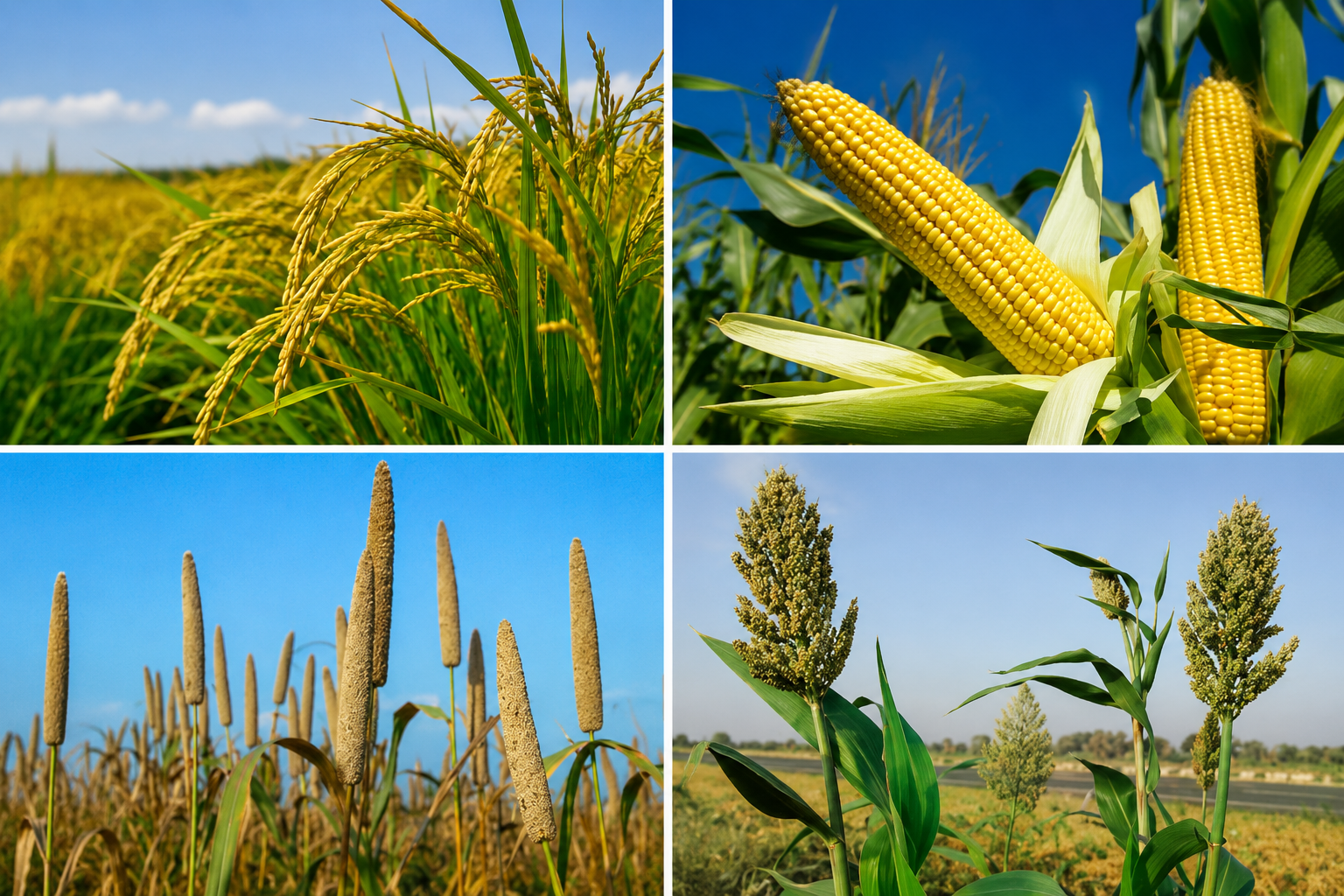
The coarse cereals story is more mixed. Area under Shri Anna and coarse cereals has declined by 4.21 lakh hectares, largely because of reductions in Karnataka and Maharashtra. Maize acreage has fallen by 3.88 lakh hectares, while ragi has declined by 2.38 lakh hectares. In contrast, bajra and jowar have registered increases.
This divergence suggests that the government’s push for millets and climate-resilient crops has yet to translate uniformly across states. Farmers ultimately respond to economics: assured demand, prices, water availability, input costs and market access often determine crop choices more than policy messaging.
Oilseeds present another concern. Acreage has declined marginally by one lakh hectares to 190.45 lakh hectares. Groundnut and soybean, the two major oilseed crops, have both recorded reductions. This is significant because reducing India’s dependence on edible-oil imports requires sustained expansion in domestic production, not merely incremental gains in productivity.
Cotton acreage has also declined marginally, while sugarcane is almost unchanged. Jute and mesta are among the few crops to record a modest increase.
The latest data therefore points to a Kharif season defined less by a broad-based acreage expansion and more by crop reallocation. The challenge for policymakers is to ensure that this transition strengthens, rather than weakens, India’s food and nutritional security.
The government’s next priority should be to align procurement, pricing, irrigation, crop insurance and extension services with this changing acreage pattern. The emerging shift towards pulses and selected crops can become a structural advantage only if farmers find these crops as financially rewarding and less risky than water-intensive alternatives.
Ultimately, India’s agricultural resilience will depend not simply on how many hectares are sown, but on what is grown, where it is grown, how productively it is cultivated and whether farmers receive a remunerative return. The Kharif acreage numbers offer an early warning — and an opportunity — to make India’s crop strategy more market-oriented, climate-resilient and nutrition-sensitive.