By BK Jha
India’s mushroom cultivation sector is gradually emerging as an important component of agricultural diversification, offering a combination of nutritional security, livelihood generation, entrepreneurship and efficient resource utilisation. Once largely confined to a few traditional production centres, mushroom cultivation is expanding across states, creating opportunities for farmers, rural women, young entrepreneurs and even those without access to conventional agricultural land. Its growing relevance lies in a simple proposition: high-value agriculture need not always require large landholdings.
India’s mushroom production reached approximately 347,450 tonnes in 2023-24, registering a growth of around 10 per cent over the previous year, according to the ICAR-Directorate of Mushroom Research. The steady expansion reflects increasing consumer interest in nutritious food, improved cultivation practices and growing commercial demand from hotels, restaurants, supermarkets and food-processing industries. India is also among the world’s leading mushroom-producing countries.
Unlike conventional crops, mushrooms can be cultivated indoors in relatively small spaces and under controlled environmental conditions. Production can be undertaken in rural, urban and peri-urban settings, with limited dependence on agricultural land. Depending on the variety and local climate, growers can also undertake multiple production cycles during the year. These characteristics make mushroom cultivation particularly attractive for small and marginal farmers, landless households and rural entrepreneurs.
A Changing Geography of Production
The mushroom economy is no longer restricted to traditional agricultural states. Bihar, Odisha, Maharashtra, Uttar Pradesh, Gujarat and Haryana have emerged as important production centres, while Uttarakhand, Jharkhand and several smaller states are strengthening their presence.
The ICAR-Directorate of Mushroom Research’s 2023-24 state-wise assessment places Bihar among the leading producers with approximately 39,250 tonnes, followed by Odisha at 35,400 tonnes and Maharashtra at 32,280 tonnes. Uttar Pradesh and Uttarakhand are also significant contributors, with production of around 27,700 tonnes and 27,390 tonnes respectively.
Small States, Big Opportunities
One of the interesting developments in this emerging landscape is the participation of smaller states. Goa, India’s smallest state by area, recorded mushroom production of approximately 9,390 tonnes in 2023-24, according to ICAR-DMR. Its contribution is noteworthy considering its geographical limitations and relatively small agricultural base.
Goa illustrates how mushroom cultivation can create opportunities beyond conventional farming. The state’s hospitality and tourism ecosystem provides a potential market for fresh, locally produced mushrooms. Hotels, restaurants, resorts and institutional kitchens offer an important consumer base, while the growing demand for premium food products creates opportunities for specialised producers.
The state also has a distinctive culinary connection with mushrooms through its traditional monsoon delicacy, wild olmi or almi. This familiarity offers an interesting cultural dimension to the development of cultivated varieties. Commercial cultivation of oyster and milky mushrooms, supported by controlled-environment practices, can help provide more consistent supplies throughout the year.
Entrepreneurs such as Dr Sangam Kurade, popularly known as Goa’s ‘Mushroom King’, have demonstrated the potential of commercial mushroom production through growing infrastructure, vertical farming and an integrated production-to-market model. The emphasis on processing, packaging and distribution is particularly relevant because mushrooms are highly perishable and require efficient post-harvest management.
The Goa government has also introduced mushroom cultivation training under the Chief Minister’s Kaushalya Path Scheme. Launched in May 2026 in collaboration with a private enterprise, the initiative aims to provide practical training in oyster mushroom cultivation and encourage small-scale agri-enterprises. Financial assistance for eligible mushroom production infrastructure under the state’s horticulture framework provides another avenue for prospective entrepreneurs.
Women and Rural Youth at the Centre of the Transformation
Perhaps the most significant dimension of mushroom cultivation is its potential to transform rural livelihoods. It offers an entry point into agribusiness for people who may not own substantial agricultural land or possess the capital required for conventional farming.
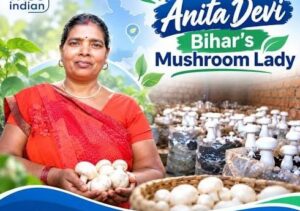 Bihar provides an important example. Anita Devi of Nalanda, popularly known as the ‘Mushroom Mahila’, helped popularise mushroom cultivation among rural women. Her initiative contributed to Anantpur village being recognised as a Mushroom Village. With institutional support and access to spawn production, the enterprise expanded into a wider community-based activity.
In Andhra Pradesh, Ruthu, a young woman from Guntur district, moved from waste picking to mushroom cultivation after receiving vocational training through the Skill Training for Rural Youth programme. Her production reached around eight kilograms daily, generating a reported monthly income of approximately Rs 35,000.
Similar entrepreneurial journeys have emerged in Gujarat and Uttarakhand. Anjanaben Gamit, a civil engineer from Tapi, established an oyster mushroom cultivation unit after receiving technical guidance from Krishi Vigyan Kendra. In Dehradun, Hiresha Verma transformed an initial experiment involving just 25 mushroom bags into a commercial enterprise with significant production capacity and employment generation.
These experiences demonstrate that mushroom cultivation is not simply an additional agricultural activity. With training, access to quality inputs and market connections, it can become an independent source of income and a platform for rural entrepreneurship.
Technology, Markets and the Next Phase of Growth
For mushroom cultivation to evolve into a stronger agribusiness sector, India must address several structural gaps. Quality spawn remains a critical input, and inadequate access to scientific production facilities can affect yields and product quality. Training institutions, agricultural universities, Krishi Vigyan Kendras and ICAR research centres need to strengthen their outreach, particularly among first-generation growers.
Policy support must move beyond capital subsidies towards an integrated approach covering training, technology, credit, infrastructure, market access and entrepreneurship development. Linking mushroom cultivation with women’s self-help groups, rural livelihood missions and agricultural waste-management programmes could further expand its reach.
India’s mushroom economy is at an important stage of transition. Its future will depend not merely on increasing production volumes but on building an efficient value chain that connects growers with consumers and converts scientific knowledge into sustainable enterprise. The sector is demonstrating that agricultural innovation need not be measured by the size of landholdings. For Indian agriculture, the mushroom may be a relatively small crop, but the possibilities it offers for nutrition, employment, women’s economic participation and sustainable farming are substantial.