BK JHA
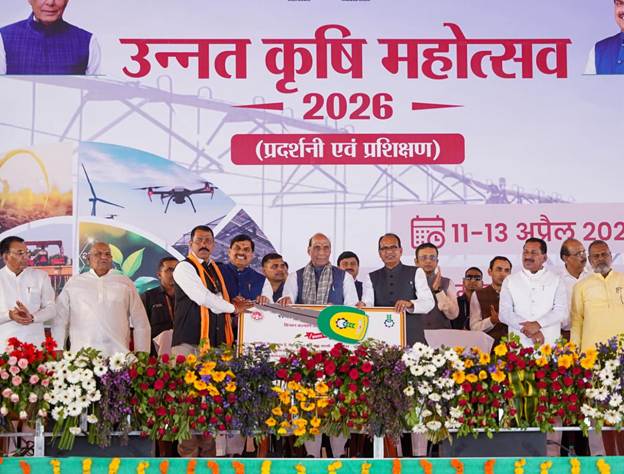
Raisen, Madhya Pradesh: In a significant policy push aimed at reorienting central India’s farm economy, the three-day Unnat Krishi Mahotsav that opened at Dussehra Maidan in Raisen has placed sharp focus on pulses expansion, local processing infrastructure, and tech-led precision farming, with the Centre announcing a cluster of actionable interventions for Madhya Pradesh.
The headline announcement—setting up 55 dal mills across the state—signals a decisive shift toward strengthening post-harvest value chains for pulses such as chana, masoor, urad, and tur. The move is expected to reduce distress sales, improve price realization, and integrate farmers with processing units at the district level. Alongside, the Centre reiterated that it will procure pulses at the minimum support price (MSP) “to the extent farmers are willing to sell,” effectively assuring market linkage in tandem with production expansion.
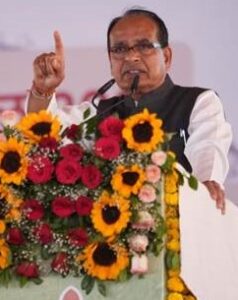 The event, inaugurated by Defence Minister Rajnath Singh, Chief Minister Mohan Yadav, and Union Agriculture Minister Shivraj Singh Chouhan, has drawn thousands of farmers, agri-scientists and stakeholders. However, beyond ceremonial optics, the Mahotsav has been structured as a working platform for implementation, with a district-specific agricultural roadmap set to be unveiled for Raisen, Vidisha, Sehore and Dewas.
District-Level Crop Planning and Diversification
Officials said that the new roadmap will provide specific advice for different crops and areas, including the best seed types, places to grow fruits and vegetables, and strategies for diversifying crops based on local climate This granular planning, which deviates from universal schemes, is anticipated to guide input use, cropping patterns, and investment decisions at the farm level.
The Centre is concurrently preparing state-wise agricultural roadmaps nationwide, reflecting a broader policy shift toward localized planning. For Madhya Pradesh, the emphasis is on transforming parts of the region into a horticulture and food processing hub, leveraging existing strengths in wheat and basmati while expanding high-value crops.
Integrated Farming Model Gets Policy Backing
A key feature at the Mahotsav is the live demonstration of a one-acre integrated farming model, which combines crops with allied activities such as dairy, poultry, beekeeping, and horticulture. According to officials, this model has the potential to generate annual incomes exceeding Rs. two lakh per acre, provided farmers adopt diversified production systems and scientific practices.
The push toward integrated farming is aimed at addressing structural challenges—shrinking landholdings, income volatility, and rising input costs—by creating multiple revenue streams within the same land parcel.
Tech Deployment: From Drones to Soil Intelligence
Technology adoption is emerging as a central pillar of the new agri strategy. The Mahotsav has showcased hydrogen-powered drones, micro-irrigation systems, solar pumps, and mechanized equipment, with live demonstrations aimed at reducing input costs and improving efficiency.
In a notable digital intervention, the government launched the mṛda/eFARM mobile app, which enables real-time soil analysis and nutrient recommendations. Farmers can assess soil health on-site and receive crop-specific fertilizer advisories, reducing indiscriminate input use and improving productivity.
This app-based approach builds on the Soil Health Card framework but moves toward on-demand, location-specific decision support, a critical requirement for precision agriculture.
Training-Led Model: 20 Technical Sessions, 4,000 Farmers Registered
Unlike traditional fairs, the Raisen Mahotsav is structured as a training-intensive programme, with over 20 thematic sessions covering horticulture, mechanization, market linkage, drone applications, and soil management. Around 4,000 farmers have pre-registered for these sessions, where scientists present followed by open Q&A interactions.
This format is designed to bridge the last-mile gap between research institutions and farm-level adoption, a persistent bottleneck in India’s agricultural extension system.
Pulses Mission and Market Integration
The expansion of the pulses mission in Madhya Pradesh aligns with India’s broader goal of reducing import dependence on protein crops. By combining assured procurement, local processing (dal mills), and advisory support, the government is attempting to create an end-to-end ecosystem—from production to value addition.
Officials noted that similar models in basmati cultivation have already demonstrated how processing infrastructure can catalyze crop shifts and enhance farmer incomes, suggesting a replication strategy for pulses.
Institutional Convergence and Year-Long Focus
The Madhya Pradesh government has declared the current year as “Kisan Kalyan Varsh” (Farmer Welfare Year), indicating sustained policy focus beyond the event. The Mahotsav itself reflects multi-departmental convergence, with participation from agencies such as IFFCO, CIMMYT-BISA, the National Horticulture Board, and fisheries and livestock departments.
On-ground exhibitions resembled a full-scale agri-ecosystem, with stalls on crop science, animal husbandry, irrigation, and food processing, alongside demonstrations of emerging technologies.
Linking Agriculture with Defence Procurement
In a lesser-noticed but potentially impactful initiative, the Defence Ministry has begun sourcing organic vegetables and millets from farmers near cantonment areas, creating institutional demand for local produce. This could open new procurement channels and stable markets for farmers adopting sustainable practices.
Economic Rationale: Strengthening the Farm-to-Market Chain
The policy thrust emerging from Raisen underscores a clear economic logic—agriculture is being repositioned not just as production but as an integrated value chain encompassing logistics, processing, and retail linkages.
By focusing on:
- Pulses processing infrastructure (55 dal mills)
- Crop diversification and horticulture expansion
- Precision farming tools and digital advisory
- Integrated farming systems
- Assured procurement mechanisms
The Centre and state are attempting to address both income enhancement and risk mitigation for farmers.
With the Raisen Mahotsav positioned as a template for future agri interventions, policymakers appear to be testing a replicable model—one that combines infrastructure, technology, training, and market assurance into a single, coordinated framework.
If implemented effectively, this approach could mark a shift from scheme-driven agriculture to system-driven agricultural transformation, particularly in states like Madhya Pradesh that sit at the heart of India’s food economy.