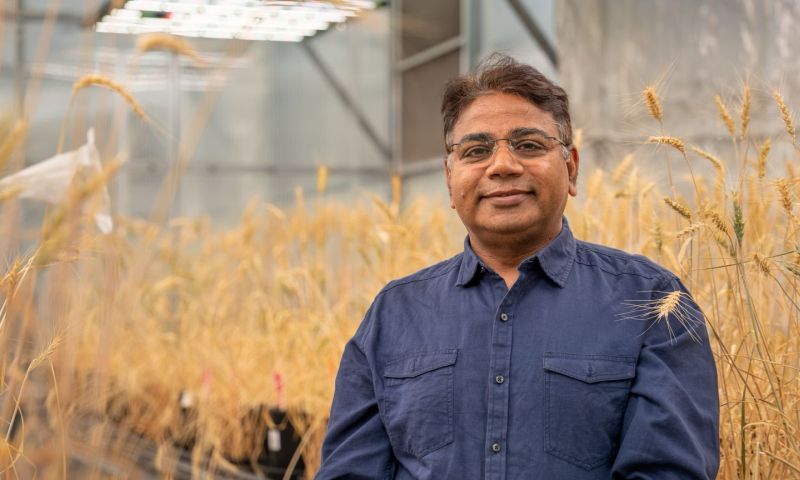
Professor Rajeev K. Varshney FRS, an internationally recognised agricultural scientist and plant geneticist, has crossed the landmark of 100,000 citations on Google Scholar, with an h-index of 155. The milestone reflects the global reach of a scientific career spanning genomics, genetics, crop improvement and agricultural research for food and nutrition security.
For Indian readers, the number has an almost sporting resonance. Sachin Tendulkar’s 100 international centuries became one of cricket’s iconic milestones. In the world of agricultural science, crossing 100,000 citations represents a similarly memorable “100” landmark. The arenas are very different, of course, but both milestones reflect sustained performance, longevity and impact over many years.
Currently based at Murdoch University, Australia, Professor Varshney’s scientific journey has taken him through institutions in India, Germany and international agricultural research. He has built extensive collaborations with scientists and institutions around the world and has contributed to advances ranging from crop genome sequencing and translational genomics to pangenomics, genomics-assisted breeding and climate-resilient agriculture.
Yet Professor Varshney is reluctant to regard 100,000 citations as an individual achievement. He describes the milestone instead as the collective outcome of students, postdoctoral researchers, colleagues, collaborators and institutional partnerships built over several decades.
In this conversation with Agriculture Post (AP), Professor Varshney (RKV) reflects on the people behind the numbers, the scale and collaborative nature of modern science, how agricultural genomics has transformed during his career, translating discoveries into breeding and farmers’ fields, and where he believes the next revolution in crop improvement will come from.
AP: Professor Varshney, you have now crossed 100,000 citations on Google Scholar. What does this milestone mean to you personally?
RKV: It is certainly a very special moment, and I feel grateful and humbled. At the same time, I do not see these as “my” 100,000 citations. They represent the collective work of many students, postdoctoral researchers, scientists, colleagues and collaborators with whom I have had the privilege of working over the years.
Science, particularly the multidisciplinary and international agricultural research that we do, is fundamentally a team effort. Many of our publications have involved large teams working across countries, crops and disciplines, sometimes for several years before the research reached publication.
You may also like to read: Pangenome breeding opens new route to higher yields and climate resilience
For me, therefore, 100,000 citations are less about the number and more about the fact that other researchers have found our collective work useful enough to read, apply, test, challenge and build upon. That is probably the most satisfying aspect of this milestone.
AP: For an Indian audience, it is tempting to compare big milestones with cricket. Sachin Tendulkar’s 100 international centuries became an iconic benchmark. Some might describe your 100,000 citations as a scientific “100K” moment. How do you react to that comparison?
RKV: I would be very hesitant to compare myself with Sachin Tendulkar! He is a legend who inspired an entire generation. But I can appreciate the spirit of the analogy; both are milestones accumulated over many years rather than achieved in a single moment.
There is, however, an important difference in science. These 100,000 citations represent the collective work of hundreds of students, colleagues and collaborators. So, if we use the cricket analogy, I would say this is very much a team score rather than an individual century. And, just as in cricket, whatever score you reach, you return to the field and focus on the next innings. There is still a great deal of science to do.
AP: When you began your scientific career, did you ever imagine reaching a milestone of this scale?
RKV: Not at all. When I started my research career, I was not thinking about citations, h-indices or rankings. I was fascinated by genetics and wanted to understand how we could use science to improve crops.
My scientific journey has taken me through Aligarh Muslim University, Chaudhary Charan Singh University, Meerut; IPK Gatersleben, ICRISAT and now Murdoch University. Each institution provided different opportunities and perspectives, and at every stage I was fortunate to work with outstanding mentors, colleagues, students and collaborators. So when I look at 100,000 citations today, I think much more about that journey and those people than about the number itself.
AP: Which scientific contributions do you believe have had the greatest impact?
RKV: It is difficult to identify one particular paper or discovery because our research has evolved considerably over the years. One major contribution has been developing genomic resources for crops that historically had limited genomic infrastructure, particularly legumes and dryland crops—from genetic maps and molecular markers to reference genomes, pangenomes and large-scale germplasm genomic resources.
The second has been translational genomics: taking genomic discoveries beyond publications and using them in breeding programmes; we call it genomics-assisted breeding. I have always believed that agricultural genomics should ultimately help breeders develop better varieties. More recently, our research has increasingly moved towards pangenomics, haplotype-based breeding, genomic prediction, artificial intelligence and genome editing.
You may also like to read: New Groundnut Varieties to Boost Farmer Incomes and Strengthen India’s Edible Oil Economy
What gives me greatest satisfaction is seeing the continuum from fundamental genomic discovery to breeding applications and, ultimately, improved crop varieties and benefits for farmers.
AP: Your research has resulted in a very large number of publications and citations over the years. How have you been able to sustain this level of scientific productivity and impact while continuing to make meaningful contributions to such a broad portfolio of research?
RKV: It is a very reasonable question. The first point I would make is: please don’t consider these as “Rajeev Varshney’s publications” alone. They are the collective output of students, postdocs, colleagues and collaborators with whom I have been fortunate to work. For many years, I have led research groups of around 40–50 people, alongside several major projects and typically 10–20 active national and international collaborations. Many papers appearing in a particular year are also the culmination of research conducted over several years.
My own role has evolved from conducting experiments myself to developing scientific ideas, designing and leading projects, mentoring researchers, building collaborations, interpreting results, and contributing to manuscript writing and critical revision. Importantly, I believe authorship must always reflect genuine scientific and intellectual contribution. Publication numbers should never be the primary measure of a scientist; quality, integrity, mentoring and scientific and societal impact matter much more than quantity. These publications reflect team science and long-term collaboration far more than individual productivity.
AP: How important has collaboration been in your career?
RKV: Collaboration has been absolutely central. Modern agricultural science is too complex for a scientist, laboratory or institution to address major challenges independently. Genomics itself increasingly brings together genetics, molecular biology, breeding, bioinformatics, quantitative genetics, physiology, phenotyping and data science.
I have been fortunate to collaborate with researchers across more than 60 countries on six continents. The diversity of those collaborations has been enormously valuable. A breeder sees a problem differently from a genomics scientist; a physiologist asks different questions from a computational scientist; and farmers often bring perspectives that none of us working in laboratories can provide. Many of the scientific advances with which I have been associated emerged precisely because we brought these different perspectives together.
AP: Beyond publications and citations, what do you regard as the most meaningful measure of scientific impact?
RKV: For an agricultural scientist, one of the most meaningful measures is whether our science ultimately makes a difference to agriculture and people’s lives. Through different collaborative programmes, our research has contributed to the development of more than 20 climate-resilient legume crop varieties, grown by farmers. Through the Tropical Legumes project, together with a large network of partners across 13 countries, we contributed to efforts that impacted the lives of more than 25 million farmers in Africa and Asia.
You may also like to read: ICRISAT, CIMMYT Launch New Initiative to Fast-Track Climate-Resilient Crops in Africa and India
Now in Australia, I am equally passionate about ensuring that our research translates into outcomes for Australian growers. We are working closely with the Grains Research and Development Corporation (GRDC) and the grains industry so that our genomic discoveries and pre-breeding outputs can feed directly into breeding pipelines. I am particularly grateful for our collaborations with Australian Grain Technologies (AGT) and the erstwhile Chickpea Breeding Australia, which have helped connect research with practical crop improvement.
Similarly, through our work with Hort Innovation, Queensland Department of Primary Industries and Western Australia’s Department of Primary Industries and Regional Development (DPIRD), we are working to accelerate the translation of genomics research into horticultural crop improvement. I therefore see scientific impact at several levels: knowledge generated, people trained, technologies developed, breeding programmes strengthened, varieties delivered and, ultimately, benefits reaching growers, farmers and society. For me, that translation from discovery to breeding to impact is one of the most rewarding aspects of agricultural science.
AP: Mentorship appears to have been another major part of your career. How do you view the role of mentoring young scientists?
RKV: Mentoring is one of the most rewarding responsibilities we have as senior scientists. Over the years, I have had the privilege of mentoring and training more than 450 scientists and researchers, including through 15 training courses, as well as supervising a large number of students and postdoctoral researchers.
I believe mentoring should go beyond helping somebody complete a thesis or publish a paper. A good mentor should help young researchers develop confidence, scientific independence, professional networks and the courage to pursue ambitious questions.
I often tell young colleagues that they should aim to become better scientists than their mentors. In fact, this is something I learned from my own mentors, including Professor P. K. Gupta and Professor Andreas Graner, who have always encouraged their students to go further than their supervisors. If each generation of scientists can enable the next generation to achieve more, that is how science progresses.
When I see my former students and postdocs establishing successful laboratories, leading research programmes, mentoring their own students and making important discoveries, that gives me enormous satisfaction. In many ways, that is a more enduring legacy than any individual publication.
AP: Agricultural genomics has changed dramatically during your career. Looking back at your own scientific journey, what have been the biggest transformations?
RKV: The transformation has been extraordinary, and I can perhaps illustrate it best through my own scientific journey. During my PhD at Chaudhary Charan Singh University, we spent almost five years working on wheat microsatellites, when developing even a few hundred SSR loci represented a substantial research effort. When I moved to IPK Gatersleben, we had entered the EST era, and we were able to generate several thousand expressed sequence tags (ESTs) and use them to develop genomic resources and molecular markers.
You may also like to read: Genetic improvement drives expansion of corn planted area in Brazil
Later, when I moved to ICRISAT, we entered the genome-sequencing era. At that time, sequencing even a single crop genome was a major undertaking, requiring substantial resources, large collaborative teams and several years of work. Over time, we contributed to developing reference genomes and genomic resources for several important crops. Today, at Murdoch University, we are in a completely different era. Advances in sequencing technologies, genome assembly, computing and data science mean that we can now contemplate sequencing hundreds or even thousands of genomes in a much faster and more cost-effective manner.
In many ways, therefore, my own scientific journey mirrors the evolution of genomics, from spending years developing hundreds of molecular markers, to generating thousands of ESTs, to sequencing individual reference genomes, and now to analysing hundreds or thousands of genomes. That gives you a sense of just how rapidly genomic science has advanced. But the transformation is not simply about sequencing faster or generating more data. The conceptual change has been equally profound. We have moved from asking, “What is the reference genome?” to asking, “What genomic diversity exists across an entire species?”
AP: Your recent work has highlighted pangenome-guided breeding. Why do you consider this approach so important for future agriculture?
RKV: Climate change presents breeders with an increasingly difficult challenge. We need crops that maintain high productivity while coping with heat, drought, salinity, nutrient limitations, emerging diseases and increasingly variable environments. Pangenomes allow us to access genetic variation that may simply be absent from a conventional reference genome.
But building a pangenome is only the beginning. The real opportunity is to identify beneficial haplotypes and structural variants, understand their effects, and systematically combine favourable variation into breeding material.
I see the future moving from pangenome construction to pangenome-informed prediction and ultimately pangenome-guided breeding. This becomes particularly exciting when pangenomics is integrated with artificial intelligence, genomic prediction and genome editing.
AP: How do you see artificial intelligence and genome editing changing crop improvement?
RKV: I believe we are moving towards an era of predictive and increasingly precise breeding. Genomics and pangenomics can tell us what variation exists. Phenotyping and environmental data can tell us how that variation performs. Artificial intelligence can help us identify patterns across enormous multidimensional datasets and predict promising genetic combinations.
You may also like to read: Indore Declaration Sets BRICS Agriculture Agenda; Focus on Food Security, Innovation and Farmers
Genome editing adds another dimension because, once we understand which gene or variant is important, editing may allow us to modify particular targets precisely. I often describe these technologies as complementary rather than competing: genomics can help tell us what to change, while genome editing can provide a precise way of making that change. The greatest advances will probably come from integrating these technologies rather than treating them independently.
AP: India has played an important role in your personal and scientific journey. What opportunities do you see for Indian agricultural science?
RKV: India has tremendous scientific talent, extraordinary crop diversity and one of the world’s largest agricultural systems. It therefore has both an enormous opportunity and a responsibility to lead innovation in agricultural science. India has built substantial capabilities in genomics, breeding, biotechnology, digital agriculture and data science. The next opportunity is to integrate these capabilities at scale and connect them even more strongly with breeding programmes and farmers’ needs.
I would particularly like to see greater investment in pangenomics, precision breeding, AI-enabled crop improvement, high-throughput phenotyping and pre-breeding using crop wild relatives and germplasm collections. India can also play a major role in South–South scientific collaboration, particularly with countries in Asia and Africa facing similar challenges of climate change, smallholder agriculture and food and nutrition security.
AP: You are now based in Australia but continue to collaborate extensively with researchers in India and around the world. How important are international partnerships for addressing food security?
RKV: Food security and climate change do not recognise national boundaries. A drought-tolerance gene discovered in a landrace from one country may eventually contribute to a variety grown thousands of kilometres away. A genomic technology developed in Australia may help analyse germplasm originating in Asia, Africa or Latin America.
That is why I strongly believe in open and responsible international scientific collaboration. Australia has world-class strengths in agricultural science, breeding, genomics and dryland agriculture. India brings tremendous scientific capacity, biodiversity and scale. International agricultural research centres contribute unique germplasm, networks and experience in translating research into smallholder farming systems. Bringing these strengths together can accelerate innovation far more effectively than institutions working in isolation.
AP: Finally, after 100,000 citations, what is the next milestone for Professor Rajeev Varshney?
RKV: I don’t really have any particular numerical target, and definitely not a citation target. At this stage of my career, the milestones that excite me are scientific and societal ones. Can we use pangenomics and artificial intelligence to design crops that are significantly more resilient to climate change? Can we improve nitrogen-use efficiency and reduce agriculture’s environmental footprint? Can genomic discoveries be translated faster into varieties that farmers actually grow? Can we train and inspire a new generation of agricultural scientists who are equally comfortable with biology, genomics, computation and artificial intelligence
And perhaps most importantly: can the science we do contribute meaningfully to feeding a growing population while protecting our natural resources? If we can make significant progress on these challenges and see our science translating into better crops, more resilient agricultural systems and tangible benefits for farmers and society, I would consider those far more important milestones than reaching any particular citation number.
The 100,000 citations are a wonderful recognition of the journey so far, and I am deeply grateful to everyone who has been part of it. But for me, this milestone is also an encouragement to keep moving forward. There is still a great deal of exciting science to do and, hopefully, much more impact to create.