BK JHA
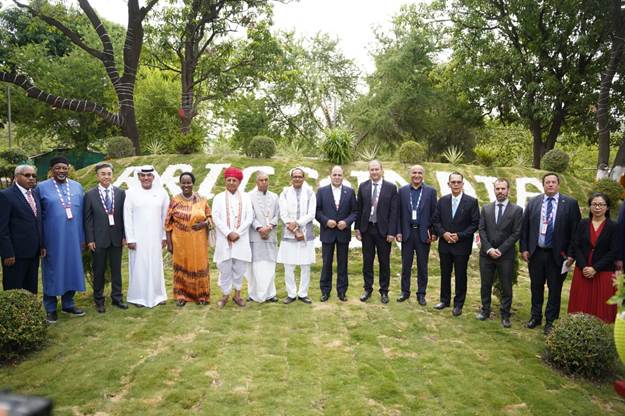
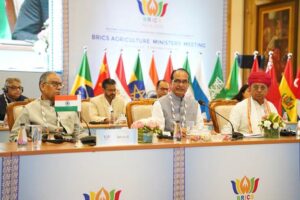
The BRICS Agriculture Ministers’ Meeting in Indore concluded with the unanimous adoption of the Indore Declaration, a landmark framework that could significantly shape the future of global agriculture, food security and farmer welfare. After the meet, Union Minister for Agriculture & Farmers Welfare and Rural Development Shivraj Singh Chouhan said that at a time of global crises and uncertainties, the BRICS meeting had sent a strong message of hope, trust and collective responsibility to the world. The declaration reflects a growing consensus among emerging economies that agriculture must remain central to sustainable development.
 BRICS nations collectively account for nearly half of the world’s population, around 42 per cent of global agricultural land and a similar share of global food grain production. Any coordinated action by the grouping therefore carries substantial implications for global food systems, agricultural trade and rural livelihoods.
The discussions in Indore revolved around four broad priorities: ensuring food and nutritional security, promoting agricultural trade, strengthening climate-resilient farming practices and accelerating technological innovation in agriculture. The meeting also highlighted the need to improve the economic conditions of farmers, particularly small and marginal landholders who form the backbone of agricultural production across many BRICS countries.
A notable feature of the declaration is its strong farmer-centric orientation. Unlike many international agricultural agreements that focus primarily on trade and production targets, the Indore Declaration places farmers’ livelihoods, access to technology, market linkages and resilience against climate shocks at the heart of policy discussions. Delegates examined challenges faced by family farmers, including access to quality inputs, affordable credit, modern technology and remunerative prices.
One of the most consequential outcomes of the meeting was the decision to establish the BRICS Network of Centres of Excellence on Agro-Ecology and Regenerative Agriculture. This platform aims to facilitate collaborative research, training and knowledge-sharing in sustainable agricultural practices. With climate change increasingly affecting crop yields, water availability and soil health, regenerative agriculture is emerging as a key strategy for balancing productivity with environmental sustainability. The network will encourage member countries to exchange experiences in natural farming, organic agriculture and soil restoration techniques.
Another major initiative is the creation of the BRICS Network on Digital Agriculture, reflecting the growing role of technology in modern farming. Artificial intelligence, geospatial mapping, digital public infrastructure and data-driven decision-making are rapidly transforming agricultural practices across the world. The new network seeks to ensure that these innovations reach farmers more effectively and help improve productivity, reduce risks and optimize resource use. As digital technologies become increasingly affordable, they are expected to play a crucial role in bridging productivity gaps and enhancing farm incomes.
The meeting also approved the establishment of a Global Forum on Farmers’ Rights in Seed Systems, a move that highlights the importance of biodiversity conservation and traditional agricultural knowledge. Across many regions, indigenous seed varieties are disappearing due to the widespread adoption of commercial hybrids. While improved seeds contribute to higher productivity, concerns remain about preserving genetic diversity and protecting traditional seed systems that have evolved over centuries. The new forum aims to promote conservation efforts while safeguarding farmers’ rights over seed resources and traditional knowledge.
Complementing this initiative is the launch of BRICS AgriN (Agro Inputs, Genetic Resources and Information Network). The platform is designed to facilitate the exchange of information, genetic resources, agricultural inputs and best practices among member countries. Such cooperation could prove especially valuable as nations seek more resilient crop varieties capable of withstanding climate stresses, pests and emerging diseases.
The declaration also underpins the importance of transforming agricultural research into practical solutions. Member countries agreed to strengthen the existing BRICS Agricultural Research Platform and evolve it into a more effective “Knowledge-to-Action Hub.” The emphasis is on ensuring that innovations move beyond research institutions and are adopted by farmers on the ground, thereby accelerating agricultural modernization.
Agricultural trade emerged as another key area of cooperation. The ministers reiterated their commitment to a fair, transparent and inclusive multilateral trading system. Discussions on strengthening trade mechanisms, including the concept of a BRICS Grain Exchange, indicate growing interest in reducing vulnerabilities associated with global commodity markets and enhancing food security through deeper cooperation.
Climate change remained a dominant theme throughout the deliberations. Delegates discussed the growing threats posed by extreme weather events, changing rainfall patterns and phenomena such as El Niño. The meeting highlighted the need for coordinated adaptation strategies, improved information-sharing mechanisms and greater investment in climate-resilient agricultural systems. Equally important were discussions on reducing food loss and wastage, which contribute significantly to greenhouse gas emissions while undermining food security.
The declaration also recognizes that the future of agriculture depends heavily on attracting youth and empowering women. Agri-startups, agribusiness ventures and technology-driven services are increasingly creating opportunities for younger generations. Encouraging entrepreneurship, innovation and skill development among rural youth was identified as a critical requirement for ensuring long-term agricultural sustainability.
The Indore Declaration signals the emergence of a coordinated BRICS approach to addressing some of the most pressing agricultural challenges facing the world. By combining technological innovation, sustainable farming practices, biodiversity conservation and farmer welfare, the declaration seeks to create a more resilient and inclusive agricultural future.