BK JHA
With the Kharif 2026 season approaching, the Union Government has rolled out a comprehensive agriculture preparedness strategy focused on quality seeds, timely credit, crop insurance reforms, natural farming and region-specific planning, signalling a shift towards a more scientific and farmer-centric agricultural ecosystem.
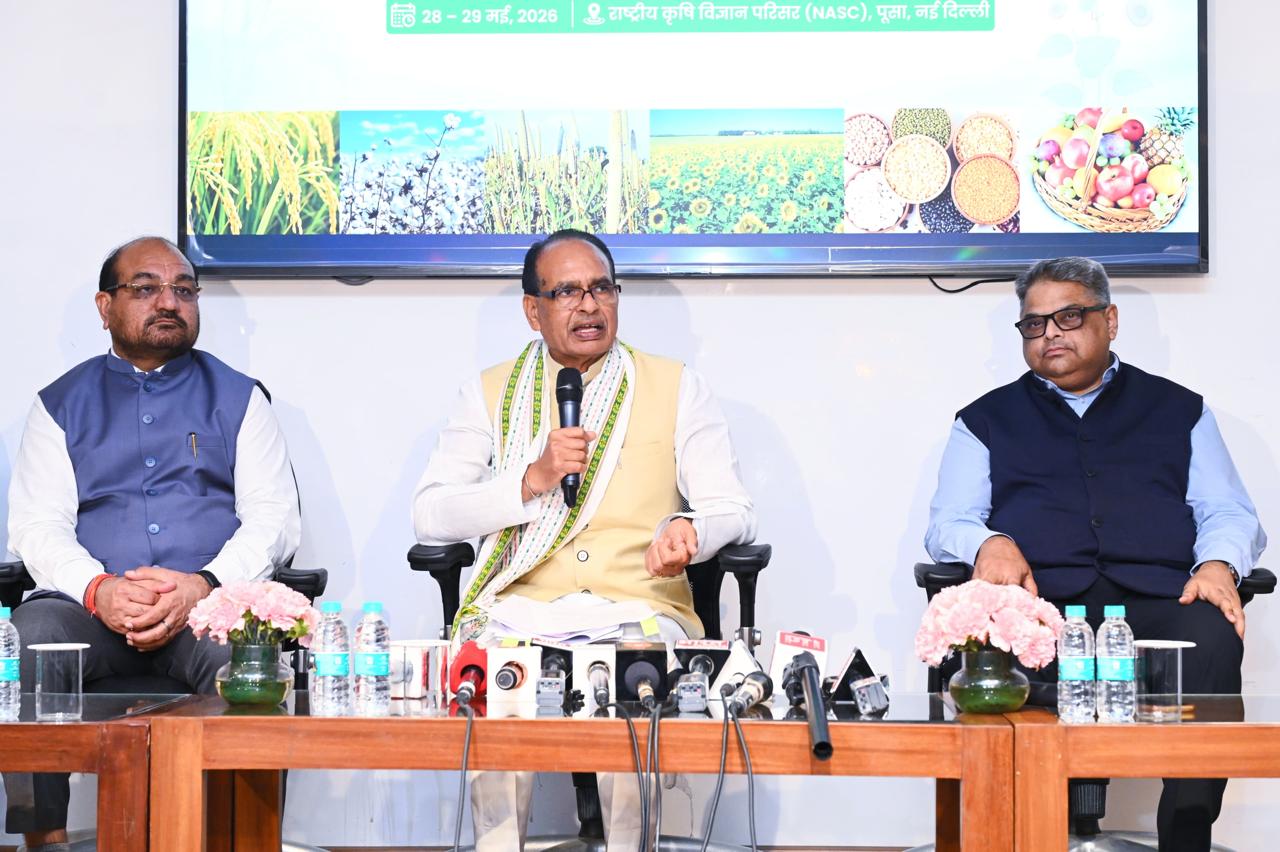
Speaking at a press conference during the National Kharif Agriculture Conference at Pusa in New Delhi on May 29, Union Agriculture and  Farmers’ Welfare Minister Shivraj Singh Chouhan said the country is fully prepared for the upcoming sowing season and has put in place measures aimed at ensuring higher productivity, better farmer support, and improved resilience against climatic uncertainties.
The conference brought together state agriculture ministers, senior officials, scientists, agricultural universities, Krishi Vigyan Kendras (KVKs) and progressive farmers to chart a coordinated national strategy for the season ahead. According to the minister, the discussions focused on key areas including seed availability, fertiliser management, crop insurance, agricultural credit, natural farming and state-wise agricultural roadmaps.
A major highlight of the government’s preparedness plan is the availability of quality seeds. Chouhan said the country requires around 173 lakh quintals of seeds for the Kharif season, while nearly 192 lakh quintals have been arranged, creating a buffer of approximately 11 per cent above requirement. The Centre has already completed seed allocations to states and has urged them to ensure timely lifting and distribution so that farmers receive seeds before sowing operations begin.
Recognising the increasing unpredictability of weather patterns, the government has also established a national seed reserve of 1.74 lakh quintals. The reserve is intended to support farmers in situations involving delayed rainfall, prolonged dry spells or the need for re-sowing due to crop damage.
Agricultural credit emerged as another major area of focus. While the national average farm loan size stands at approximately ₹1.32 lakh, the minister noted significant regional disparities, particularly in eastern India where credit penetration remains low. The Centre plans to engage with banks and state governments to improve credit flow in underserved regions and ensure that farmers have timely access to capital for agricultural investments.
The government is also examining ways to extend the benefits of agricultural schemes to tenant farmers who cultivate leased land but often remain outside the formal support system. Chouhan said successful models adopted by some states would be studied to develop a broader framework that can address the needs of this large but often overlooked farming community.
On crop insurance, the minister acknowledged the need for improvements in implementation and accountability. A dedicated team will be formed to strengthen crop loss assessment through better crop-cutting experiments and more reliable remote-sensing technologies. The Centre has also taken a firm position on delays in premium payments and claim settlements. Under existing provisions, a 12 per cent interest liability can be imposed when payments are delayed beyond stipulated timelines after necessary formalities are completed, ensuring that farmers receive compensation more promptly.
Quality control of agricultural inputs remains a critical concern. Chouhan described counterfeit seeds, substandard pesticides and poor-quality agricultural products as a serious threat to both farmers and the agricultural economy. States have been urged to increase sampling, strengthen testing facilities and expand NABL-certified laboratories. A nationwide campaign against fake agricultural inputs is also being planned to protect farmers from financial losses and productivity setbacks.
In a significant policy direction, the Centre announced that every state will prepare its own agriculture roadmap tailored to local soil conditions, climate, nutrient profiles, crop suitability and fertiliser requirements. The objective is to move away from a one-size-fits-all approach and create more scientific, location-specific agricultural strategies.
Natural farming and integrated farming systems also featured prominently in the discussions. According to the minister, nearly 20 lakh farmers have registered for natural farming across about 8 lakh hectares. Integrated farming, particularly for small and marginal farmers, is being promoted as a practical pathway to income enhancement and risk diversification.
To take awareness directly to the grassroots, the Centre and states will jointly launch the month-long “Khet Bachao Abhiyan” from June 1 to June 30. The campaign will focus on balanced fertiliser use, soil health management, natural farming practices, improved crop management and awareness about government schemes. Field-level outreach activities will also seek to facilitate access to Kisan Credit Cards, mechanisation support and Soil Health Cards.
The message emerging from the Kharif Conference is clear: agriculture is being repositioned as a national mission driven by scientific planning, timely execution and farmer empowerment. From seed security and insurance reforms to natural farming and state-specific strategies, the Centre is seeking to build a more resilient and productive agricultural sector capable of meeting both domestic needs and future global opportunities.